
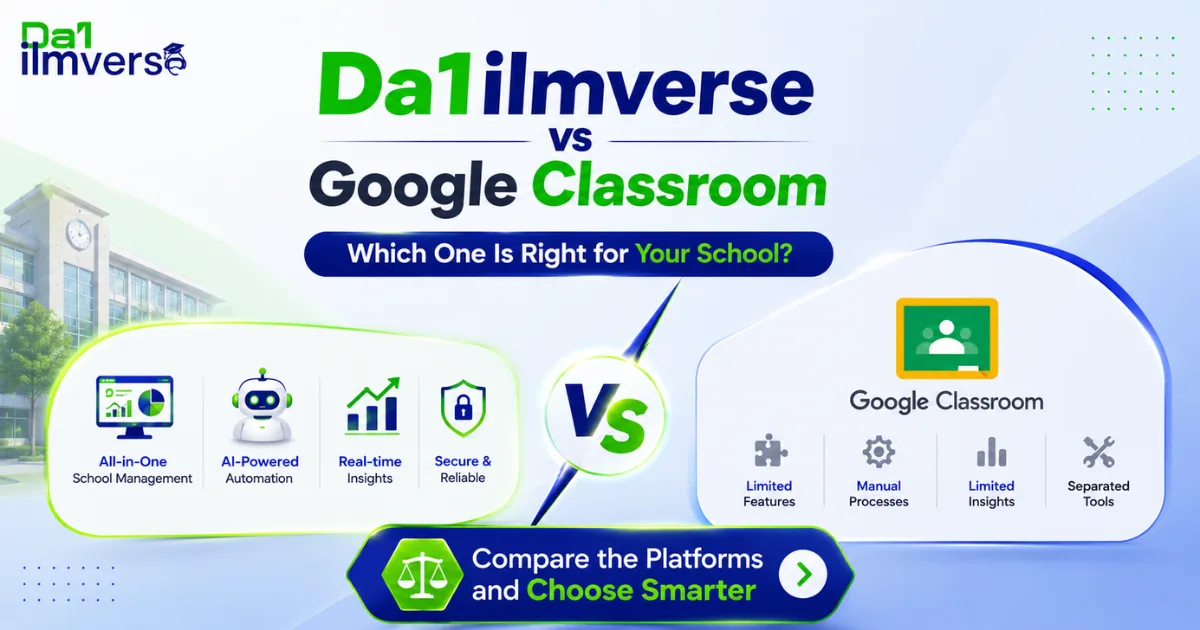
Managing a modern K-12 school with outdated tools is like trying to run a marathon in quicksand. School administrators and educators are drowning in a sea of disconnected Excel sheets, static PDF assignments, and manual timetable planning. While Google Classroom has long served as a reliable repository for digital documents, forward-thinking educational institutions are actively seeking Google Classroom alternatives that do more than just host files. They need systems that spark true student engagement and automate heavy administrative burdens. Enter Da1ilmverse, an all-in-one AI-driven and immersive 3D learning platform designed specifically to bridge the gap between static education and the interactive digital worlds where modern students live.
For administrators short on time, here is how the two platforms directly compare across critical institutional metrics:
| Feature / Metric | Google Classroom | Da1ilmverse |
| Primary Function | Flat document-sharing & assignment repository | Immersive 3D/VR learning + Complete ERP Automation |
| Learning Methodology | Passive text and video consumption | Active, hands-on, real-time 3D simulation |
| AI Personalization | Basic automated grading assistants | Predictive student analytics & adaptive pacing algorithms |
| School Administration | None (Requires external SIS/ERP integrations) | Full automated timetables, grading registers, and ERP |
| Parental Engagement | Weekly automated email summaries | Dedicated parent-student-teacher communication stream |
The most glaring contrast between these platforms lies in how students absorb knowledge. Google Classroom operates fundamentally as a digital filing cabinet. Teachers post text instructions, link YouTube videos, and collect digital worksheets. The student's role remains largely passive, reading screens and typing responses. Conversely, Da1ilmverse transforms passive learning into dynamic exploration by combining virtual reality classroom software with responsive 3D environments. Instead of reading about the solar system from a PDF link, students step directly into a virtual space, interacting with planetary scales and physics engines in real time.
While Google Workspace leverages standard AI for simple template suggestions and smart replies, its classroom environment lacks deep, individualized student tracking. Da1ilmverse deploys purpose-built, specialized algorithms explicitly engineered for precision learning. The integrated AI dynamically monitors student behavior, interaction patterns, and performance metrics. If a student struggles with a specific geometry concept inside a 3D module, the system catches the friction point before a test ever happens.
Choosing a legacy system means a school has to manage different software for attendance, grading, billing, report cards, and parent communication. Da1ilmverse solves this by bringing all these tools together in one unified dashboard through Ilmversity. It handles the entire lifecycle of an educational institution under a unified login with AI-Generated Timetables, Instant Attendance and Registers, and Streamlined Promotion Protocols.
In traditional tech ecosystems, parents are often left on the periphery, receiving occasional email summaries that lack actionable insights. Da1ilmverse natively builds a robust, cloud-based bridge connecting parents, teachers, and school leadership through its unified mobile and web interface. Parents gain access to live, real-time progress metrics of their child's academic track, automated notifications regarding behavioral analytics, and even specialized parenting support materials.
If your objective is to position your institution as a leader in 21st-century education, Da1ilmverse is the superior investment. By unifying AI educational tools for K-12, immersive virtual spaces, and complete administrative automation, it systematically removes the daily friction points that exhaust teachers and alienate parents.
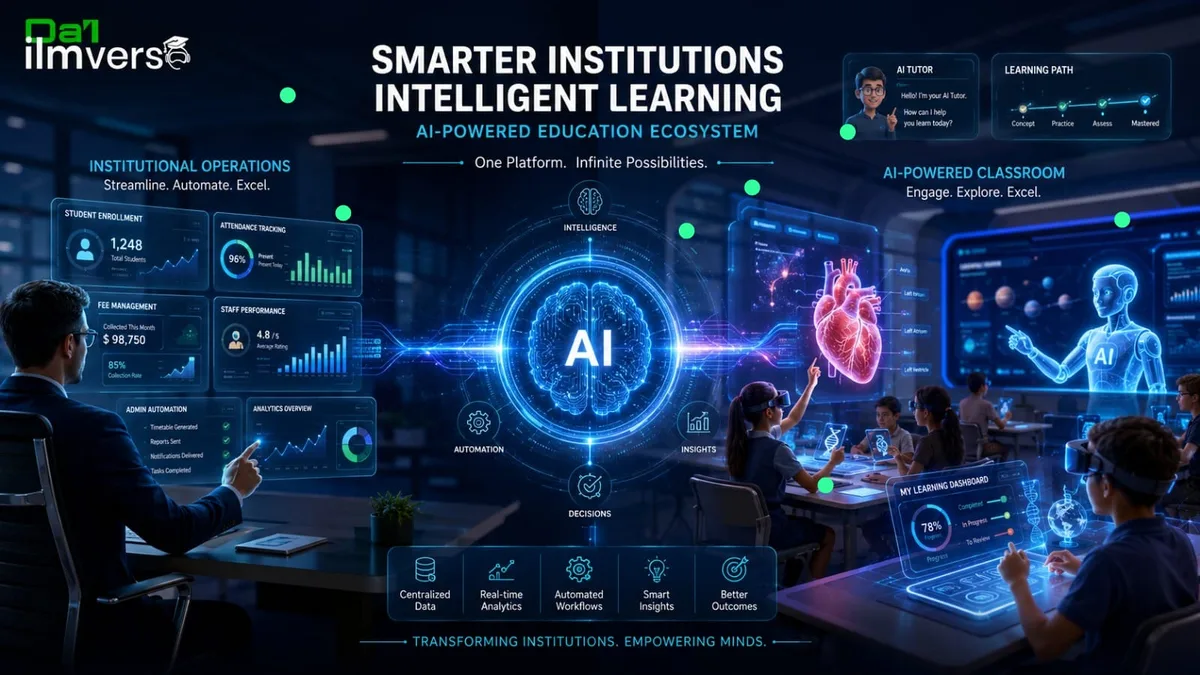
Most educational institutions do not suffer from a people problem; they suffer from a systems problem. Manual tracking, disconnected tools, and static classrooms constantly drain administrative productivity and student engagement. Today's digital-native students grow up in interactive, rich digital worlds, yet they are still being forced to learn in passive environments. To bridge this gap, modern institutions are upgrading to centralized, cloud-based configurations. Leading this global paradigm shift is Da1ilmverse, an advanced platform merging artificial intelligence and immersive technology to redefine institutional management and standard classroom learning.
Read More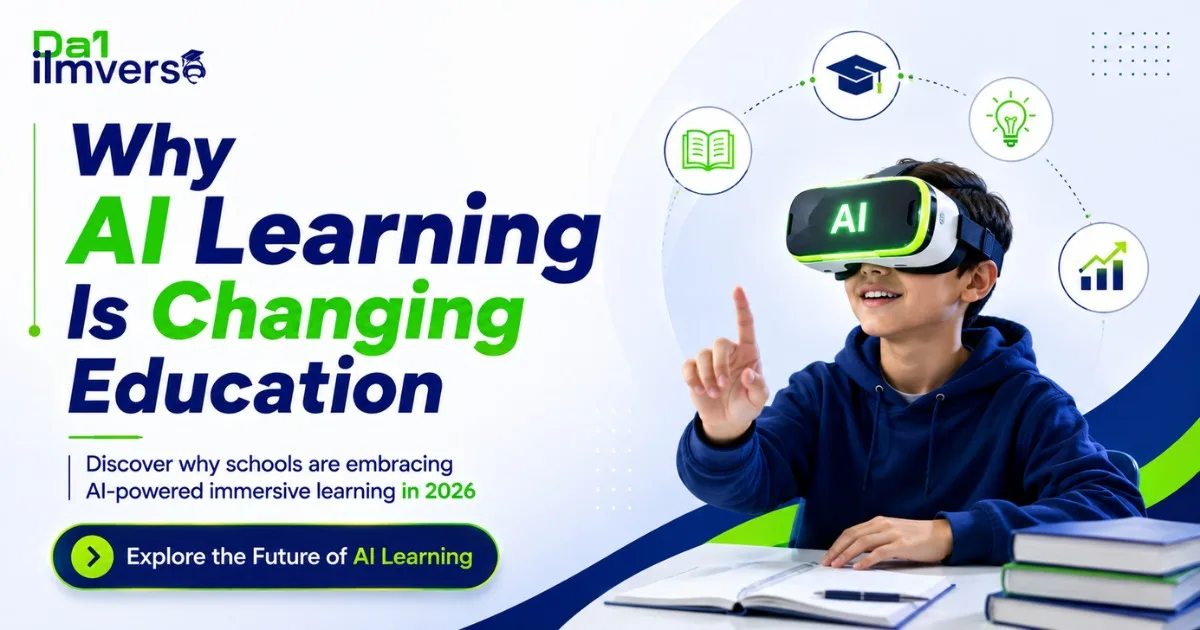
Think back to how you learned physics, history, or coding. A teacher stood at the front of a crowded classroom, writing on a board or clicking through static slides. You copied notes. You memorized formulas. And within days after the exam, most of it faded away. Now compare that with what is happening in education in 2026. A student puts on a lightweight VR headset and suddenly finds themselves standing on the Moon. They jump and instantly experience lunar gravity in real time.
Read More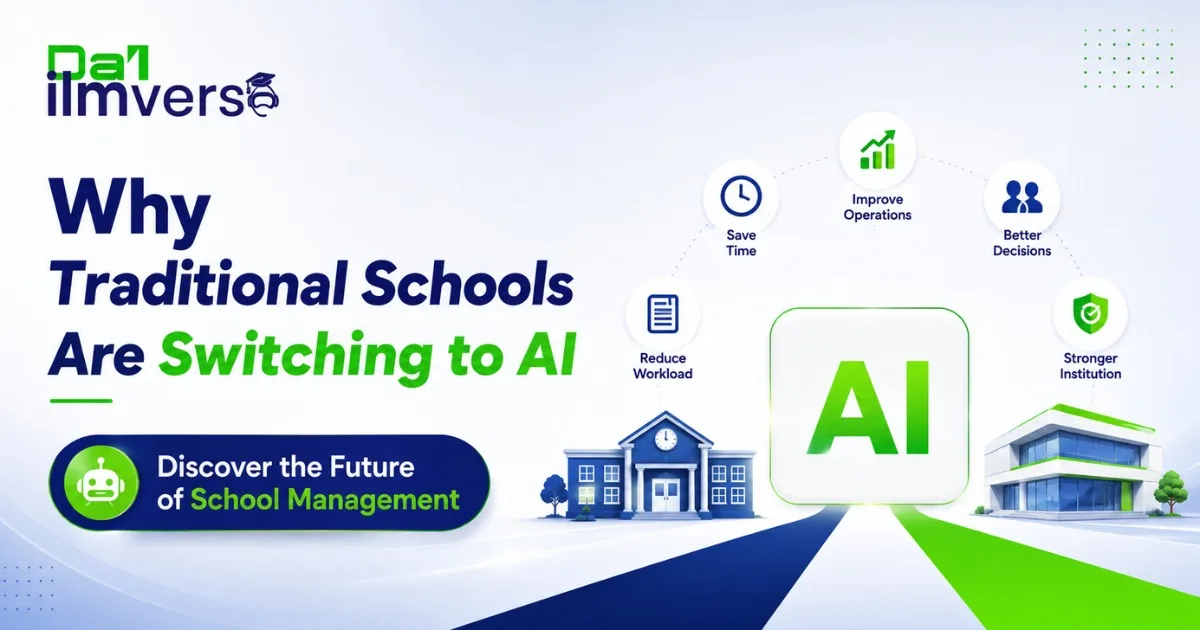
Is your school growing, or is it just getting busier? If your administrative "to-do" list is drowning out your academic vision, you aren't running a school; you're managing a paper trail. Managing a modern K-12 school, private college, or cross-city educational network requires navigating a relentless flow of daily tasks. School owners, principals, and institutional directors balance admissions, fee tracking, teacher schedules, and parent communication, which often leaves little room for academic growth.
Read More